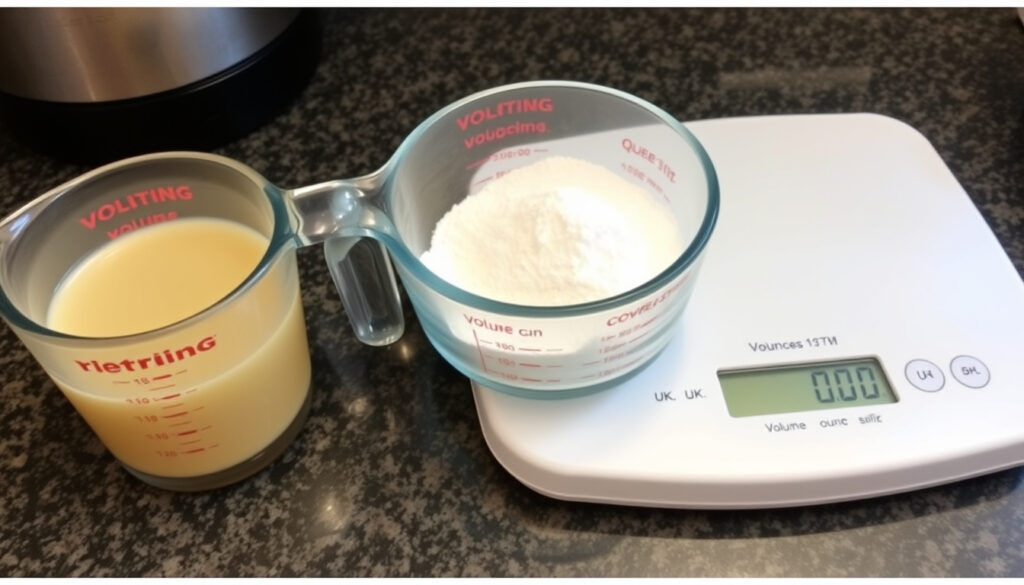
How Many Ounces in a Cup? US, UK, Dry & Liquid Conversions
Ounces can mean volume or weight, and that distinction is the root of most kitchen measurement errors; when a recipe calls for 1 cup of flour, your scale reads ounces, and you’re not sure if that’s 8 oz or something else—it’s a moment every home cook knows. This guide walks through the exact conversions for US and UK cups, explains why dry ingredients weigh different amounts per cup, and offers a practical weight table for common baking ingredients so you can cook with confidence.
Fluid ounces in 1 US cup: 8 ·
Weight of 1 cup all-purpose flour: 4.25 oz (120 g) ·
Weight of 1 cup water: 8.33 oz (236.6 g) ·
Volume of 1 UK cup: 8.45 fl oz (250 ml)
Quick snapshot
- 1 US cup = 8 US fluid ounces (volume) (Pastries Like a Pro (conversion expert))
- 1 UK cup (cooking) = 250 ml = 8.45 US fl oz (100 Days of Real Food (real food resource))
- Dry ounces measure weight; fluid ounces measure volume (100 Days of Real Food (real food resource))
- Exact weight of “1 cup of flour” can vary 15-20% depending on scooping method vs spoon-and-level (100 Days of Real Food (real food resource))
- Historical cup sizes differ: US legal cup = 240 ml vs US customary cup = 236.6 ml (Metric Conversions (conversion authority))
- US cup standard defined by US customary system (ongoing, no recent change) (Metric Conversions (conversion authority))
- UK/Commonwealth adoption of metric cup (250 ml) since 1970s, now standard in Australia, NZ, Canada cooking (Chef Lola’s Kitchen (cooking authority))
- Digital scales increasingly replace volume measurement in home baking for accuracy (100 Days of Real Food (real food resource))
- More recipe creators now include both volume and gram measurements (100 Days of Real Food (real food resource))
| Measurement system | Volume | Equivalent fluid ounces |
|---|---|---|
| US customary cup | 236.6 ml | 8 US fl oz |
| US legal cup (nutrition labeling) | 240 ml | 8.12 US fl oz |
| UK metric cup (modern cooking) | 250 ml | 8.45 US fl oz |
| UK imperial cup (traditional) | 284 ml | 10 UK fl oz |
Is 1 cup 8 oz or 16 oz?
The standard US liquid cup is 8 fluid ounces
- 1 US cup = exactly 8 US fluid ounces by volume (Pastries Like a Pro (conversion expert))
- 1 US fluid ounce = 29.5735 ml (Newark (engineering conversion resource))
- 1 US cup = 236.588 ml approximately (Metric Conversions (conversion authority))
- 1 US cup = 16 US tablespoons (USDA Food Buying Guide (U.S. government))
Why you might see 16 oz for dry ingredients
A 16 oz measurement on a dry ingredient package refers to weight ounces (the net weight of the contents), not the cup volume. For example, a bag labeled “16 oz” could hold about 3.8 cups of all-purpose flour because each cup of flour weighs roughly 4.25 oz by weight—not 8 oz. The confusion is baked right into the packaging.
The implication: when a recipe says “1 cup,” it almost always means 8 fluid ounces of volume. But if you’re measuring dry ingredients by volume, the weight in ounces will differ from that 8 oz figure—sometimes dramatically.
“1 cup always equals 8 fluid ounces (volume). But it does not always equal 8 ounces by weight.”
Home bakers who assume 1 cup of any dry ingredient weighs 8 oz will overshoot flour by nearly 90%—that’s the difference between a fluffy cake and a brick. The only way to be certain is to measure by weight with a digital scale.
The implication: knowing the difference between fluid ounces and weight ounces is the foundation of accurate baking.
How many dry ounces are in a cup?
Dry cup vs liquid cup: same volume, different packing
- Dry measuring cups are designed to be filled to the brim and leveled off with a straight edge
- Liquid measuring cups have a spout and are filled to a line, then read at eye level on a flat surface
- Both hold the same volume: 8 US fluid ounces (100 Days of Real Food (real food resource))
- Dry ounces (weight) measure mass; fluid ounces (volume) measure space (100 Days of Real Food (real food resource))
Common dry ingredient weights per cup
Six common baking ingredients, one pattern: each weighs a different number of ounces per cup because density varies.
| Ingredient | Weight per 1 US cup | Weight per 1 US cup (grams) |
|---|---|---|
| All-purpose flour (spoon-and-level) | 4.25 oz | 120 g |
| Whole wheat flour | ~4.8 oz | ~136 g |
| Granulated sugar | 7.1 oz | 200 g |
| Brown sugar (packed) | 7.5 oz | 213 g |
| Butter (1 stick = 1/2 cup) | 4 oz | 113 g |
| Rolled oats | 3.2 oz | 91 g |
What this means: there’s no single “how many dry ounces in a cup” answer. The number depends entirely on what you’re scooping. For flour, it’s about 4.25 oz; for sugar, it’s nearly twice that. That’s why professional bakers weigh ingredients—volume is a rough guide, but weight is truth.
If you scoop flour directly with the measuring cup (rather than spooning it in and leveling), you can pack 5.5 oz into what’s still called “1 cup.” That 30% over-measure is the leading cause of dry, dense baked goods at home.
What this means: there’s no single answer for dry ounces per cup; it depends entirely on ingredient density.
How many ounces is a cup in the UK?
UK imperial cup vs US customary cup
- 1 UK cup (modern cooking) = 250 ml = 8.45 US fluid ounces (100 Days of Real Food (real food resource))
- Traditional UK imperial cup = 10 UK fluid ounces (Chef Lola’s Kitchen (cooking authority))
- Australia, New Zealand, and Canada also use the 250 ml metric cup in modern recipes (Chef Lola’s Kitchen (cooking authority))
UK fluid ounce is different from US fluid ounce
- 1 US fluid ounce = 29.5735 ml (Newark (engineering conversion resource))
- 1 UK fluid ounce = 28.41 ml (Metric Conversions (conversion authority))
- 1 UK fluid ounce ≈ 1.04 US fluid ounces (Metric Conversions (conversion authority))
- 1 US cup = 8.33 UK fluid ounces (Unit Converters (conversion platform))
The trade-off: if you’re following a British recipe that calls for a “cup” and you’re using US measuring cups, you’re off by about 5.6%—enough to throw off a delicate sponge cake. UK recipes published after the 1970s tend to use metric weights, which sidesteps this problem entirely.
“A measuring cup that amounts to 1 cup or converted measurements of 8 ounces…”
How many oz in a cup of flour?
Weight of flour: all-purpose, whole wheat, bread flour
- 1 cup all-purpose flour (spoon-and-level) = 4.25 oz (120 g)
- 1 cup whole wheat flour = ~4.8 oz (~136 g)—heavier due to bran content
- 1 cup bread flour = ~4.5 oz (~128 g), similar to all-purpose but can vary by brand and protein content
- Standard measuring method matters: spoon flour into cup, then level with a straight edge (100 Days of Real Food (real food resource))
Why measuring by weight is more accurate
Flour is compressible. Scooping with the measuring cup can pack 5.5 oz into what’s labeled “1 cup,” a 30% error. Weight measurements eliminate this variable entirely. For baking recipes that rely on precise ratios (like macarons, croissants, or chiffon cakes), a digital scale is non-negotiable for consistent results.
- Fluff the flour with a spoon to aerate it.
- Gently spoon the flour into the dry measuring cup until it overflows.
- Level off with the straight edge of a knife or spatula.
For the home baker in the US, the single most impactful change you can make is switching from volume to weight for flour. One inexpensive digital scale eliminates the largest source of baking failure—and costs less than a single ruined batch of cookies.
The pattern: weight measurements eliminate the variable of packing, giving consistent results.
How many grams in a cup?
Grams per cup for common ingredients
Seven everyday ingredients, one pattern: each has a unique gram weight per cup because density varies.
| Ingredient | Grams per 1 US cup | Ounces per 1 US cup |
|---|---|---|
| Water | 236.6 g | 8.33 oz |
| Butter | 227 g | 8 oz |
| Granulated sugar | 200 g | 7.1 oz |
| All-purpose flour | 120 g | 4.25 oz |
| Brown sugar (packed) | 213 g | 7.5 oz |
| Honey | 340 g | 12 oz |
| Rolled oats | 91 g | 3.2 oz |
Converting US cups to metric
- Conversion factor: 1 US cup = 236.588 ml (Metric Conversions (conversion authority))
- For water-based liquids, 1 ml weighs approximately 1 g, so 1 cup water ≈ 236.6 g
- For other ingredients, multiply volume by ingredient-specific density to get grams
- Most reliable method: use a digital scale with a tare function (100 Days of Real Food (real food resource))
The pattern: a scale removes all guesswork. Once you know that 1 cup of flour weighs 120 g and 1 cup of sugar weighs 200 g, you can convert any recipe with confidence—and stop second-guessing whether your measuring technique is accurate.
For a comprehensive breakdown of these differences, see our detailed guide on ounces in a cup.
Frequently asked questions
What is the difference between a liquid measuring cup and a dry measuring cup?
Liquid measuring cups have a spout and are designed to be filled to a line and read at eye level on a flat surface. Dry measuring cups are meant to be filled to the brim and leveled off with a straight edge. Both hold the same volume—8 fluid ounces—but the technique differs to ensure accuracy for the ingredient type.
How do I measure 1 cup of flour correctly?
Use the spoon-and-level method: fluff the flour with a spoon, gently spoon it into the dry measuring cup until it overflows, then level off with the straight edge of a knife. Never scoop directly with the measuring cup—that packs the flour and can add 30% more weight than intended. (100 Days of Real Food (real food resource))
Does 8 oz of water equal 1 cup?
Nearly. 8 US fluid ounces of water equals 1 US cup by volume. By weight, 1 cup of water weighs 8.33 oz (236.6 g) because water density is 1 g/ml. For most cooking purposes, 8 oz of water is close enough to 1 cup, but for baking precision, use the exact weight.
How many fluid ounces are in a US legal cup?
The US legal cup (used for nutrition labeling) is 240 ml, which equals about 8.12 US fluid ounces. The US customary cup (used in cooking) is 236.6 ml, or 8 US fluid ounces. The difference is small—about 1.4%—and rarely matters outside commercial food labeling.
Can I use a liquid measuring cup for dry ingredients?
You can, but it’s less accurate for dry ingredients because you can’t level them off cleanly. Dry measuring cups are designed for scooping and leveling. For liquids, liquid measuring cups are essential because you need to read the meniscus at eye level.
Why do some recipes call for 1 cup of butter as 8 oz?
Butter is sold in sticks, and 1 standard stick (1/2 cup) weighs 4 oz. So 1 cup of butter equals 2 sticks, which weighs 8 oz by weight—a rare case where volume and weight happen to match, because butter’s density is close to water’s. 1 cup of butter = 227 g = 8 oz.
How many cups are in a pint, quart, or gallon?
1 US pint = 2 cups = 16 fluid ounces. 1 US quart = 4 cups = 32 fluid ounces. 1 US gallon = 16 cups = 128 fluid ounces. (Pastries Like a Pro (conversion expert) and USDA Food Buying Guide (U.S. government))
Is a coffee cup the same as a measuring cup?
Not typically. A standard coffee mug holds about 8-12 fluid ounces, but it’s not calibrated. A “coffee cup” in recipe contexts (especially older ones) sometimes refers to 6 fluid ounces, the traditional teacup size. Always use a proper measuring cup for recipes—especially baking.
For the home baker, switching to a digital scale removes the guesswork and ensures consistent results every time.
Related reading
More related posts
 پخش زنده شبکه ۳ – Direct HD Links, Schedule and Viewing Guide
 Layla Jenner: Age, Nationality, Real Name & Kardashian Rumors
 Cast of the Sopranos – Actors, Roles and Post-Show Careers
 Can You Unsend an Email? Gmail, Outlook Guide
 DNA Test in Ireland: Cost, Accuracy, and Where to Buy
 Tom Burke: Fact vs. Fiction on Cleft Lip, Partner, Kids
 What Is Paprika Made From? Ingredients, Types & Health Benefits
 Print Shop Near Me: Where to Print Documents, Photos & More